
About
Keep it, unswag it, swap it, or pass it on.
Why this exists
When I left Indeed after fifteen years, I didn’t know what to do with all the swag. Dozens of T-shirts, sure, but also luggage, sneakers, jackets, electronics, blankets...even lip balm with a logo on it.
During the recent wave of tech layoffs, I heard about people dumping their swag on the way out. I get why that felt good in the moment, but most of it was perfectly good stuff, and it went straight to the landfill.
That’s where Unswag started. Some of that swag is worth keeping, and we’ll show you how to get the logo off. The rest deserves a better home than a dumpster, whether that’s someone who’ll wear it, a donation bin, or a textile recycler. And if you’ve always wanted a Google sweatshirt without working at Google, we can help with that too.
Quinn
Fairfield, Connecticut
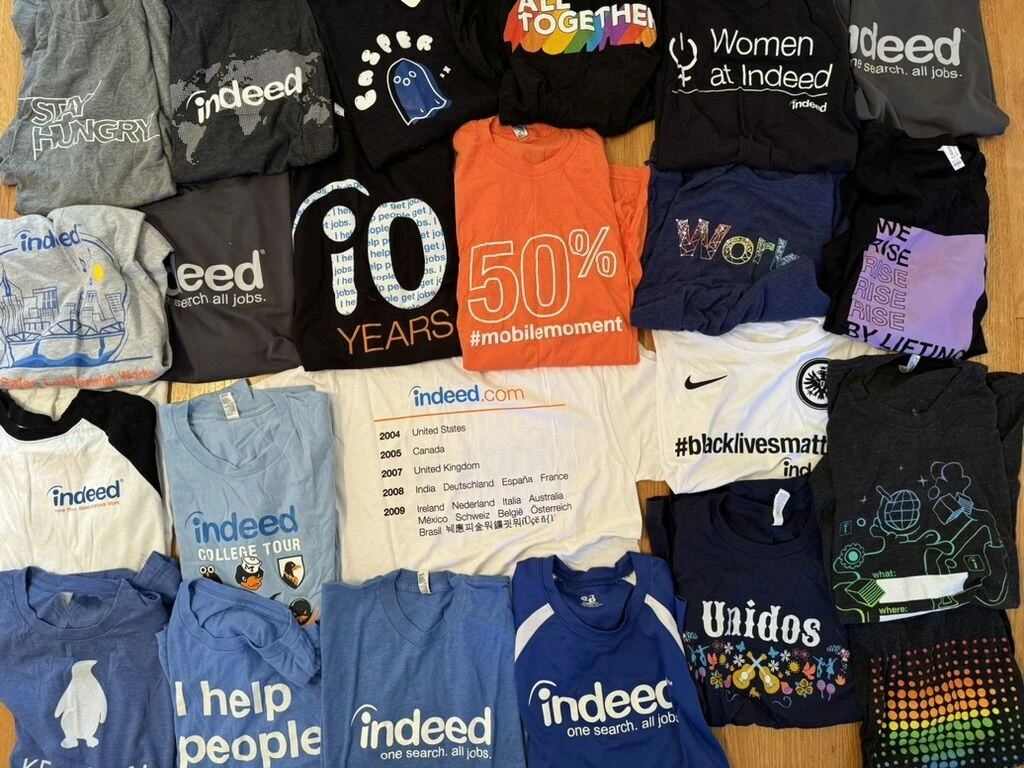
“I could outfit a small nation with the amount of Indeed swag I have accumulated.”
From my last-day post on LinkedIn, August 2024. Read the post
Free swag isn’t free. Someone paid for it, and the planet’s still paying.
One warning before the numbers. Most research on swag is paid for by companies that sell it. Industry groups want to prove swag works, and vendors want to prove the old way fails so you’ll buy their new way. We use their numbers anyway, and we tell you who’s talking.
How much gets bought
| Number | What it means | Who’s saying it |
|---|---|---|
| $27.1B | U.S. promotional products sales through distributors in 2025, the highest on record. | PPAI 2025 Sales Volume Estimate Promo industry trade group |
What happens to it
| Number | What it means | Who’s saying it |
|---|---|---|
| 30.5% | Employees who said the last swag they got was exactly what they’d have picked for themselves. | SwagDrop 2026 Employee Swag Study Survey of 2,500 U.S. and Canadian employees, run by a swag vendor |
| 37.9% | Employees who still regularly use the last piece they received. | |
| 14% | Employees who had already donated or thrown out the last piece. | |
| 4.8% | Employees who would rather get nothing at all than another generic item. |
What buyers are starting to say
| Number | What it means | Who’s saying it |
|---|---|---|
| 67% | Corporate swag buyers who count swag as a success only when people choose to wear or use it. | Custom Ink 2026 Swag Trends Survey Survey of 1,000+ buyers, run by a swag vendor |
Why companies keep buying
| Number | What it means | Who’s saying it |
|---|---|---|
| 85% | Consumers who remember the company that gave them a logoed item. | ASI 2026 Global Ad Impressions Study Promo industry trade group, nearly 5,000 consumers |
| 3,400 | Times a promotional T-shirt gets seen over its life. Bags come in at 3,300, and outerwear at 6,100, the most of any item. People keep a typical promotional item about a year. | ASI Global Ad Impressions Study, 2019 edition Promo industry trade group |
In fairness, swag does work as advertising when people want it and use it.
Where textiles end up
| Number | What it means | Who’s saying it |
|---|---|---|
| 17M tons | Textiles in U.S. municipal waste in 2018, the most recent year the EPA has published. | U.S. EPA, Textiles data Federal agency |
| 11.3M tons | Textiles sent to U.S. landfills in 2018. | U.S. EPA, Textiles data Federal agency |
| 66% | Share of U.S. textile waste sent to landfill in 2018. Another 19% was burned for energy, and 15% was recycled. | U.S. GAO report on textile waste Federal watchdog, citing EPA data |
| 13% | Recycling rate for clothing and footwear specifically. | U.S. EPA, Textiles data Federal agency |
What one T-shirt costs
| Number | What it means | Who’s saying it |
|---|---|---|
| 2,720 L | Water footprint of one 250-gram cotton T-shirt. About 1,230 liters is irrigation, 1,110 is rain the crop absorbs, and 380 is water needed to dilute the pollution. | Chapagain et al., UNESCO-IHE, summarized by ScienceBlog Academic water accounting |
We last checked these in September 2026. If you know a better source, email us.
Questions
Is this stuff real?
Most of what’s on Swap it is other people’s eBay listings, and we go by what the seller says. That’s why every tag says “Seller-described.” Check the seller’s photos, feedback, and return policy before you buy. eBay’s buyer protection covers items that aren’t as described. Anything marked “From Quinn’s closet” is ours, and we’ll vouch for it.
Are you affiliated with these companies?
No. We’re not connected to any company whose merch we list or link to.
How does buying work?
Secondhand swag on Swap it sells on eBay, so you get eBay’s checkout and buyer protection. Patches and stickers in the Store are printed to order and ship from our print partner.
Do you make money from the links?
A little. Some links to eBay pay us a small commission when you buy. Your price stays the same.
How do I get rid of my swag?
A few ways. If you’re selling it on eBay, email us the link and we may feature it. If you’d rather hand it off, tell us what you have and we may take it. Still wearable but nobody wants it? Pass it on to a donation spot, or recycle it if it’s worn out. And if you’d rather keep it, unswag it.
What happens to swag I send you?
If someone will wear it, we list it. If not, we recycle it through Trashie. Worn out already? Skip us and pass it on. You cover shipping, and since we’re not a charity, there’s no tax receipt.
Can I sell swag my company gave me?
Usually, yes. It’s yours. Skip anything marked confidential or tied to an unreleased product, and if you still work there, check your company’s policies first.
Will removing a logo damage it?
It can. Embroidery often leaves needle holes, and solvents can dull a finish. Each guide says what to expect, and when in doubt, cover the logo instead.
What if I ruin something?
It can happen. Our guides are general tips, not guarantees, and any removal method can damage fabric, finishes, or electronics. You’re responsible for how you use these steps and the tools we sell or link to. Take care with blades, irons, heat, and solvents. If an item is valuable or sentimental, covering the logo is the safer bet, and swapping it is safer still.
What if nobody wants it?
Then it should be recycled, not trashed. Pass it on lists places that take worn-out clothing, electronics, and batteries.